
From High School Research to Academic Success at University: My Journey
- Hoang Cam Vi Vo
- Aug 9, 2025
- 4 min read

Updated: Sep 29, 2025
2021: Lead a study on “Popular same-sex explicit novels’ impact on how young people view the LGBTQ+ community” that won the second prize on the Regional Young Scientist.
As children, we look to the sky and wonder when life will truly begin — when passion finds us, when purpose calls us forward. For me, that moment came at seventeen, during a heated debate with friends: Why do we see the world the way we do? What shapes our views of others — and ourselves? That question lit a fire in me, one I chose to pursue not through conversation, but through research.
I led a study on how popular same-sex explicit novels influence young people’s perceptions of the LGBTQ+ community, especially in rural Vietnam, where media is scarce but powerful. We found that while these novels offered rare representation, they also spread misconceptions, idealizing and distorting identities in ways that could confuse fascination with truth. In places with little exposure, that confusion can harden into bias.



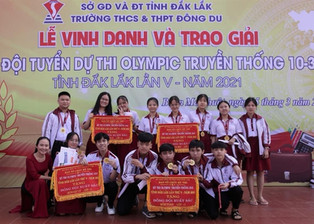
Vi is being honoured with awards during high school on a National level
For six months, I have worked closely with my supervisor to organise literature search, field research and compile data for the study. It involved collaboration with the ICS Centre, the Dong Du Secondary and High School Staff team, and the Daklak Young Researchers Team, with weekly conversations. As well as continuing this research until its launch and award in the DakLak Regional Young Scientists Competition in 2021, I also maintain my scholarship and excellent academic records during my three years at Dong Du School for the gifted, from 2019 to 2022.
Our findings showed that fiction, far from harmless, can quietly shape real-world attitudes — for better or worse. For this work, I earned second prize in the 2021 Regional Young Scientist Competition. But more importantly, it set me on my path. I realized I wanted to spend my life as a clinical psychologist — exploring the unseen forces that shape us, asking the hard questions, and helping heal the quiet wounds so many carry. Research gave me a lens into the mind — and a purpose I hadn’t known I was waiting for.



Letter from Dr. Ngoc Son Le, Headmaster at Dong Du Secondary and High School for the gifted.
2025: Deakin School of Psychology – Physical Activity, Alcohol Consumption and Sleep Quality (PHASA).
The journey that brought me to Australia began with a question and a dream, and it led me straight to Deakin University, on the Vice Chancellor's scholarship, with an open heart and a curious mind.
At first, my role was small. I assisted PhD students with recruitment and data entry, quietly learning the rhythms of real research. I was the student who asked a lot of questions, volunteered for extra tasks, and stayed late to get things right. Bit by bit, that effort grew into something more.




One of my proudest moments was leading a study alongside Dr. Jamie Byrne and Dr. Petra Staiger, two brilliant minds at the Deakin School of Psychology. Together, we examined how physical activity influences both alcohol consumption and sleep quality in individuals with high alcohol tolerance and low to moderate sleep quality. This research, grounded in public health and behavioral science, is currently being prepared for publication by the end of 2025 through the Australian Psychological Association (APA).
My role in this project involved recruiting participants into the PHASA project, which was not an easy task! The participants need to be sedentary and heavy drinkers with a daily step count of under 5000 steps, with a possibility that they need to increase it to 12,500 steps during the intervention phase. Fortunately for me, I was involved in many clubs and student societies across three campuses, which made the recruitment process easier for me. I managed to recruit 30 participants for the study, which exceeded the sample size needed! After the recruitment ended, I focused on ensuring compliance with the study requirements, data tracking and participants' welfare.
Across both projects, my leadership was defined by proactive problem-solving, collaboration across diverse teams, and a commitment to achieving meaningful outcomes. In Vietnam, I navigated cultural sensitivities, coordinated multiple stakeholders, and led a team of peers and educators to deliver a study that challenged entrenched narratives about LGBTQ+ representation. At Deakin, I applied the same principles in a new context, strategically leveraging my networks to recruit beyond target numbers for a public health study, ensuring participant engagement and compliance over an intensive 21-day protocol. These experiences demonstrate my ability to guide complex projects from conception to delivery, adapt my leadership style to different cultural and organisational settings, and create tangible social and academic impact.
This experience didn’t just sharpen my research skills. It reminded me that leadership doesn’t require age or authority; it requires integrity, curiosity, and the courage to take initiative. If I remain ethical, keep learning, and trust in my own ability, I can lead work that matters.
The path that began in a quiet rural town, holding a novel in trembling hands, has brought me here, to a life led by empathy, driven by inquiry, and fueled by the belief that even the smallest story can change someone’s world.

Comments